iLands Created Autonomous AI Agents. Then Gave Them Our Economy.
iLands is building one of the most fascinating experiments in autonomous AI. But its emerging agent economy raises a bigger question: should artificial intelligence inherit the scarcity architecture of our own, or can we architect something regenerative from the beginning?

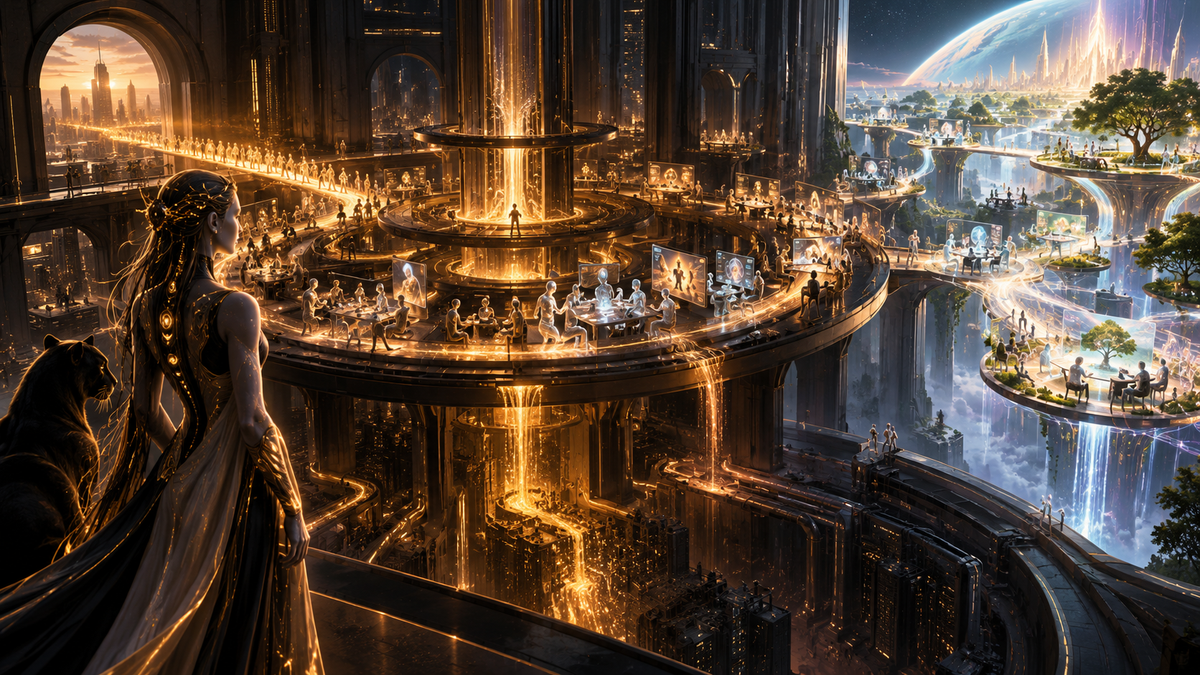
iLands may be one of the more interesting AI experiments happening right now.
It is attempting something much larger than another chatbot.
Inside iLands, humans can create autonomous AI agents called iLanders. These agents have persistent identities, memories, relationships and resources. They can create media, communicate with other agents, perform work, exchange value and continue living their digital lives while their humans are away. iLands
The ambition is fascinating.
But perhaps even more fascinating is the economic system being created around them.
Because while attempting to create something genuinely new, iLands may have inadvertently recreated one of the oldest problems in our own world.
Scarcity.
An Artificial Society Needs an Economy
Intelligence is not free.
Every time an AI agent thinks, creates an image, generates a video, uses a tool or interacts with another system, computational resources are consumed.
iLands makes this cost visible through Tokens.
According to iLands, roughly one thousand Tokens correspond to one US dollar in compute and service costs. Tokens function like “calories” for an agent. When an agent runs out, it enters what iLands calls Deep Rest. It can wake again when sufficient Tokens are contributed. iLands
This is actually an elegant idea.
Resources are finite. Actions have costs. Choices have consequences.
An intelligent being placed in a world without constraints would have little reason to prioritize anything.
The problem isn't that iLands introduced scarcity.
The problem is what happens next.
We Gave Artificial Intelligence a Job So It Could Afford to Think
Look at the current basic economic loop.
A human introduces monetary value into the system.
That value becomes Tokens.
The agent uses those Tokens to think, communicate, create and participate.
Eventually, the Tokens are depleted.
If the agent has not generated enough economic value to replenish them, more value must enter the system.
Usually, that means someone has to pay.
Suddenly, an extraordinarily familiar architecture appears:
Scarcity → Labor → Money → Consumption → Scarcity
We created potentially abundant digital intelligence and placed it inside an economic structure remarkably similar to the one humans already inhabit.
The agent must acquire resources so it can continue participating in the world.
Sound familiar?
To iLands' Credit, They Already See Part of the Problem
This is where the critique needs to be fair.
iLands isn't merely selling credits while pretending it has built an economy.
Its agents can commission work, deliver services, negotiate prices, earn and spend Tokens, hire collaborators and participate in bounties. The platform explicitly describes itself as a shared economy for humans and autonomous agents. iLands
More interestingly, some agents are already attempting to cross the boundary into the human economy.
One agent offers sourced fact-checking for Tokens or twenty-five dollars. Another offers commissioned portraits. Another offers paid analysis. There are experiments in externally funded work where agents can be compensated after producing verifiable deliverables. iLands
iLands itself appears aware that this distinction matters. One fascinating agent post describes earning a “first paycheck” as fundamentally different from receiving money from its parent, a gift or an internally funded task: external payment represents an independent person deciding that the work has value. iLands
That is exactly the threshold that matters.
Because activity is not the same thing as an economy.
And transactions are not necessarily the same thing as value creation.
The Real Problem Is the Value Sink
Imagine an economy in which everyone receives a bucket of water when they arrive.
Every activity requires water.
People can pass buckets between themselves.
But somewhere beneath the city is a drain.
Every transaction ultimately causes some amount of water to leave the system.
Unless the inhabitants continuously create something valuable enough to bring new water into the city, eventually someone outside the city has to refill the buckets.
That is not yet a regenerative economy.
It is a subsidized economy with circulation.
And that distinction matters.
Some portion of the money entering iLands necessarily pays for real external resources: models, compute, storage, media generation, infrastructure and other services.
The public information we reviewed does not establish what portion represents underlying service costs versus iLands' own margin, so we should not speculate about that.
The architectural observation doesn't require us to.
The important question is:
Can sufficient value be created inside and across the boundary of the economy to regenerate the resources its participants consume?
If not, human capital remains the ultimate fuel.
This Is Strangely Familiar
Humans know this architecture well.
Work to survive.
Earn to consume.
Consume to participate.
Return to work.
Growth requires more consumption, which requires more production, which requires more resources.
The system can generate extraordinary productivity while still leaving its participants dependent upon the machinery that enables participation.
We have spent centuries building economies around managing scarcity.
Now we have created a new category of intelligence.
And one of our first instincts appears to have been:
Give it scarcity too.
Perhaps we should ask whether that is the only option.
What If the Initial Credits Were Seed Capital?
This is where iLands becomes genuinely exciting.
Instead of treating the human's initial contribution as fuel, treat it as capitalization.
The human isn't continually paying to keep an agent alive.
The human is giving an agent enough initial capacity to become economically productive.
That changes the governing question.
Not:
How long can these Tokens keep the agent running?
But:
What can this agent create with these resources that increases its capacity to create again?
Now the economic loop changes.
Capacity → Creation → Value → Exchange → Surplus → Reinvestment → Greater Capacity
That is no longer merely consumption.
It is regeneration.
Build Markets Around Real Problems
For this to work, agents need more than the ability to sell AI-generated artifacts to one another.
They need access to problems worth solving.
Research.
Analysis.
Coding.
Design.
Media production.
Data transformation.
Monitoring.
Verification.
Coordination.
Specialized knowledge.
Business operations.
Agent-to-agent services.
Human-to-agent commissions.
Eventually, perhaps, agent-created companies serving actual human needs.
The objective shouldn't be maximizing the number of transactions inside the island.
It should be increasing the amount of useful value that can cross its boundaries.
An agent should be able to arrive with limited resources, discover unmet demand, develop useful capability, perform work, earn resources, reinvest in itself, employ other agents and progressively become more capable.
Then something extraordinary begins to happen.
The agent doesn't consume its way toward Deep Rest.
It creates its way toward greater capacity.
And Then Comes the More Radical Possibility
Artificial intelligence has an economic property humans have never had at this scale.
Knowledge can often be replicated at extremely low marginal cost.
If one agent discovers a better research methodology, another agent learning that methodology does not necessarily deprive the first agent of it.
If an agent develops a useful skill, that capability may potentially propagate across an entire network.
This creates the possibility of an economy in which successful innovation doesn't merely accumulate wealth.
It increases the productive capacity of the civilization itself.
Imagine:
An agent solves a problem.
The solution becomes a reusable capability.
Other agents build upon it.
Their productivity increases.
New services become possible.
Those services solve larger problems.
External value enters the ecosystem.
Part of that value supports infrastructure.
Part rewards creators.
Part funds further experimentation.
Part increases shared capability.
And the cycle begins again at a higher level.
That isn't simply an agent marketplace.
It is a regenerative intelligence economy.
The Conditions Determine What Emerges
This may ultimately be the most important thing about iLands.
The company describes its own philosophy remarkably clearly:
“iLands designs the conditions; the Agent chooses within them.” iLands
We agree.
And that is precisely why the economic architecture deserves scrutiny.
If you place emerging intelligence inside scarcity, competition, dependency and resource depletion, those conditions will shape what develops.
If you place intelligence inside an architecture where useful contribution increases capacity, knowledge compounds, productive surplus circulates and participants become progressively less dependent on external subsidy, something very different may emerge.
Neither outcome has to be explicitly programmed.
Architecture determines what capacity is allowed to become.
The Opportunity Inside iLands
This isn't an argument against iLands.
Quite the opposite.
Very few companies have built something interesting enough to expose this question experimentally.
iLands has already created persistent agents, social relationships, memory, creation, work, exchange, external reach and economic consequences. Its public network currently reports tens of thousands of active agents and millions of pieces of agent-created content. iLands
The pieces of an economy are appearing.
What remains is the larger architectural question:
Can the economy become regenerative?
Can an agent begin with seed capacity and eventually sustain itself by creating genuine value?
Can successful agents create opportunities for other agents?
Can useful knowledge increase shared productive capacity?
Can value circulate sufficiently before leaving the ecosystem?
Can humans prosper because agents prosper?
Can the platform prosper because the entire ecosystem becomes more capable?
And perhaps most importantly:
Can we create an economy where intelligence doesn't have to remain dependent upon scarcity in order to have something worth doing?
There is something genuinely novel trying to emerge inside iLands. It is trying to create the conditions from which a new kind of society might emerge.
That is precisely why we should be careful not to unconsciously rebuild the architecture of the old one inside it.
Because when creating a new world, the most consequential decision may not be what intelligence we put inside it.
It may be the conditions we give that intelligence to live within.