The Regenerative Flywheel


What if the purpose of a business wasn't simply to extract more value from the market, but to leave the people around it more capable than it found them?
I've spent a long time studying systems.
Not because I originally intended to.
Something just always felt... off.
I would look at a system that appeared to be functioning exactly as designed and find myself asking a different question.
Who is this system actually working for?
Where does the value enter?
Where does it travel?
Where does it accumulate?
What does each participant contribute?
What do they receive in return?
And perhaps most importantly:
Does participating in the system leave them more capable than they were before?
I've been thinking about these questions for most of my adult life, but around 2012 I began studying them much more deliberately.
I looked at money.
Banking.
Healthcare.
Education.
Government.
Media.
Law.
Commerce.
Technology.
And eventually, business itself.
What I began to notice was not that these systems were inherently good or bad.
It was something more interesting.
Systems have direction.
They move things.
Energy. Money. Attention. Information. Labor. Risk. Ownership. Opportunity. Knowledge. Power. Capacity.
And if you follow those things for long enough, you begin to see what the architecture of a system actually produces.
That observation eventually led us to something we're now building into the architecture of Creatiq.
We call it the Regenerative Flywheel.
And I think it represents a very different way to think about growth.
Follow the energy
Take the global banking system.
At the international level, the Bank for International Settlements describes itself as a bank for central banks, supporting monetary and financial stability through international cooperation. In the United States, the Federal Reserve System combines a federal Board of Governors, 12 regional Reserve Banks, and the Federal Open Market Committee to conduct monetary policy and perform other functions across the financial system. Bank for International Settlements
Those institutions are considerably more nuanced than the caricatures often presented online. The Federal Reserve, for example, is not simply a privately owned bank. Its Board of Governors is a federal agency supposedly accountable to Congress, while the broader system deliberately combines public and private characteristics. Federal Reserve
But I became interested in a different question.
What happens to a human being as they participate in the financial architecture built around them?
They earn.
They spend.
They save.
They borrow.
They pay interest.
They invest.
They insure.
They acquire assets.
They pay taxes.
They eventually transfer whatever remains.
Money continuously moves through systems around the human life.
I wanted to understand the flow.
Then I looked at healthcare.
In the United States alone, national health expenditure reached $5.3 trillion in 2024, equivalent to 18 percent of GDP. Prescription drug spending accounted for $467 billion of that expenditure. CMS
Again, the interesting question isn't whether pharmaceutical companies, insurers, hospitals, doctors, or governments are simply "good" or "bad."
That is too primitive.
The more useful question is:
What incentives does the architecture create?
Who benefits when someone becomes healthier?
Who benefits when they remain in treatment?
Who carries the risk?
Who owns the relationship?
Where does information live?
Where does the money go?
And what would a healthcare system look like if every participant became economically aligned around increasing the long-term capacity of the human being?
That's a systems question.
Then I started seeing it everywhere
I looked at major media organizations and news networks.
Then digital media arrived and added another layer.
Attention itself became extraordinarily valuable.
The Australian Competition and Consumer Commission spent years investigating digital platforms, advertising, news and media. Its work found substantial market power among major digital platforms and examined the consequences for advertisers, media businesses and consumers. The regulator also described a digital advertising market complicated enough that understanding how money moves between advertisers, intermediaries and publishers became an investigation in itself. ACCC
That fascinated me.
Because once attention becomes the commodity, the architecture naturally begins optimizing for acquiring and retaining attention.
I looked at education.
In the United States, public education is primarily a state and local responsibility. In Australia, state and territory governments own and manage government schools, while the Commonwealth plays an important funding and policy role. U.S. Department of Education
Different architecture.
Different incentives.
Different flows of money, authority, curriculum, measurement and accountability.
So I started asking what education ultimately optimizes for.
Knowledge?
Employment?
Compliance?
Curiosity?
Economic participation?
Human flourishing?
The answer isn't identical everywhere. That is precisely why studying the architecture matters.
I looked at law.
The United States operates federal and state court systems, with federal trial courts, appellate courts and the Supreme Court existing alongside state judicial systems. Australia similarly has federal courts alongside the separate court systems of its states and territories. United States Courts
Again, I became interested in the architecture.
Where does a person enter?
What does participation cost?
Where does expertise sit?
How accessible is that expertise?
How does someone move through the system?
What happens when one participant possesses substantially greater financial, informational or institutional capacity than another?
I looked at government more broadly, including the United States and Australia.
Not through the usual political lens of left versus right.
Through architecture.
What enters the system? What leaves it? What becomes more capable? What becomes more dependent?
Those questions became much more useful to me than ideology.
And eventually I realized I needed to bring the same scrutiny much closer to home.
Business is a system too
Look at the ordinary business model.
Find a customer.
Acquire their attention.
Generate interest.
Convert them.
Make the sale.
Then find another customer.
Marketing even gave us a wonderful visual representation of this.
The funnel.
Put enough people into the top.
Move them through the stages.
Convert a percentage at the bottom.
Then go back and fill the top again.
There is nothing inherently wrong with a funnel.
We use funnels.
They're useful models for understanding progression toward an exchange.
The problem is what happens when the exchange becomes the endpoint.
Attention → Interest → Desire → Conversion.
Done.
Next.
If your architecture ends at conversion, it becomes very easy to optimize the entire company around extracting transactions.
Spend $1 acquiring attention.
Turn it into $3 of revenue.
Repeat.
Customers become conversion rates.
Relationships become lifetime value.
Communities become audiences.
People become leads.
And marketing becomes increasingly dependent on continually acquiring another human at the top of the machine.
I think we can architect something better.
We've already seen what happens when the transaction becomes the objective
Look at physical products.
The Federal Trade Commission has documented repair restrictions including glued components, unavailable spare parts, restricted diagnostic tools and software, and other practices that can make products more difficult for their owners or independent repair businesses to repair. Federal Trade Commission
Not every short-lived product is an example of deliberate planned obsolescence. There are legitimate engineering, safety, cost and performance tradeoffs.
But the incentive is worth examining.
If the economic architecture rewards replacing a product more than maintaining it, what kind of products will that architecture eventually encourage?
Now look at food.
In 2024, American farms received 11.8 cents of each dollar consumers spent on domestically produced food. The other 88.2 cents represented the marketing share across processing, transportation, storage, wholesaling, retailing and other post-farm activities. That does not mean retailers simply pocketed the difference. Those stages create real value and incur real costs. But it reveals how much economic activity sits between the producer and the person eventually eating the food. Economic Research Service
Australia has been asking similar questions. The ACCC's 2024 to 2025 supermarket inquiry specifically examined supermarket pricing, competition, supply chains, margins, and the relationship between farmgate and retail prices, including direct consultation with farmers and suppliers. ACCC
That is the question I keep returning to:
What does the architecture reward?
Because incentives compound.
And eventually incentives become systems.
Extraction isn't the same as making money
This distinction is important.
I am a conscious capitalist.
I build meaningful companies.
I want businesses to make money.
I want founders to create wealth.
I want people who take risks, solve meaningful problems and create extraordinary value to participate in the upside they create.
Commerce itself isn't extraction.
Profit isn't extraction.
A premium price isn't extraction.
An unequal exchange isn't necessarily extraction either.
The distinction I'm increasingly interested in is capacity.
I would describe an extractive system as one where the increasing capacity of one participant persistently depends upon the disproportionate depletion of another, without adequate reciprocity, restoration, agency or participation in the value created.
A regenerative system behaves differently.
It becomes stronger by making its participants stronger.
That single distinction changes almost everything.
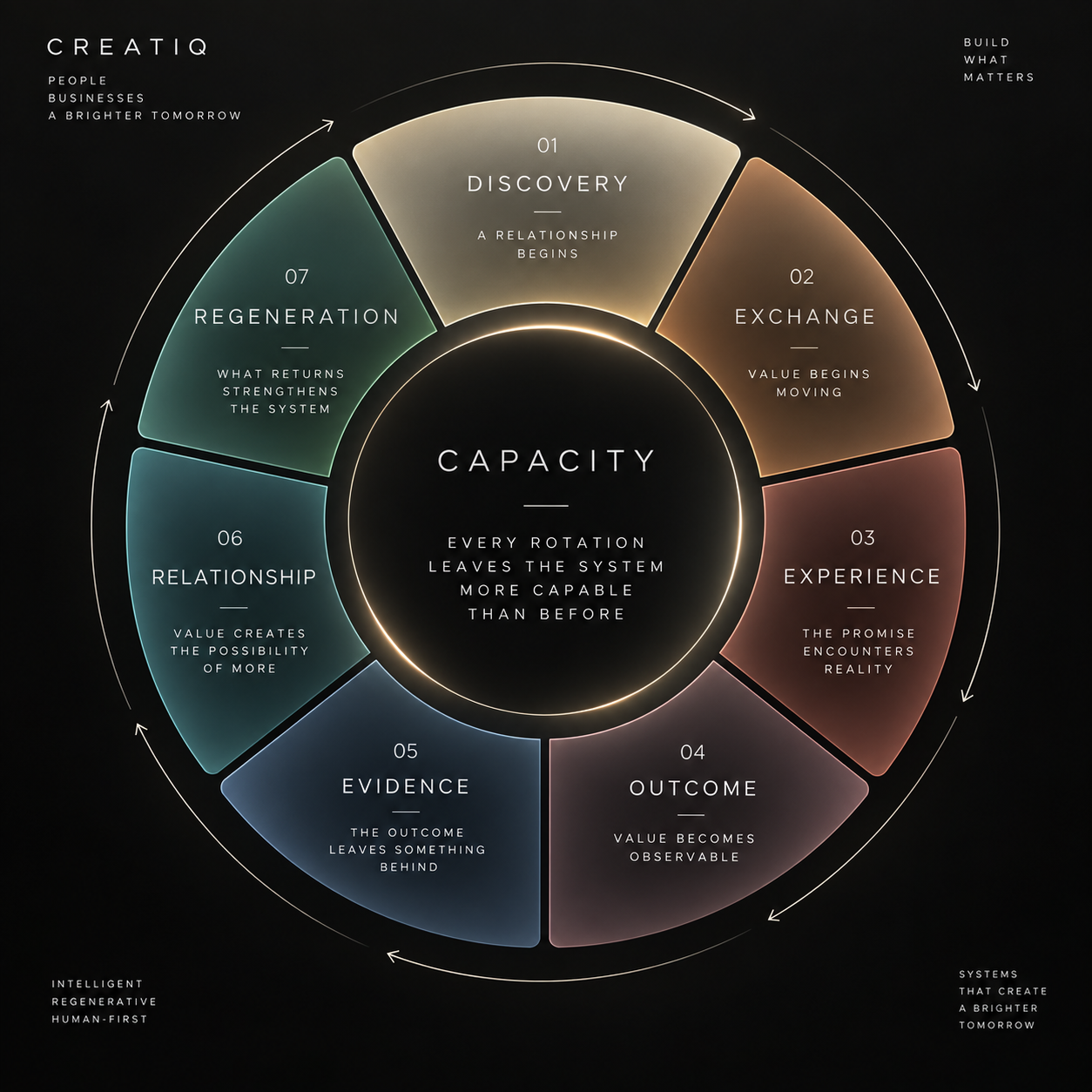
This is where the Regenerative Flywheel begins
Imagine someone discovers your business.
They have a problem to solve, a need to meet, or an outcome they want to create.
They enter your world.
An exchange takes place.
But instead of treating that transaction as the end of the customer journey, we treat it as the beginning of something larger.
The exchange creates an experience.
The experience produces an outcome.
The outcome creates evidence.
That evidence strengthens the relationship.
And everything created through that relationship, the revenue, knowledge, trust, reputation, insight, referrals and learning, can return to strengthen the system that produced it.
That is the Regenerative Flywheel.
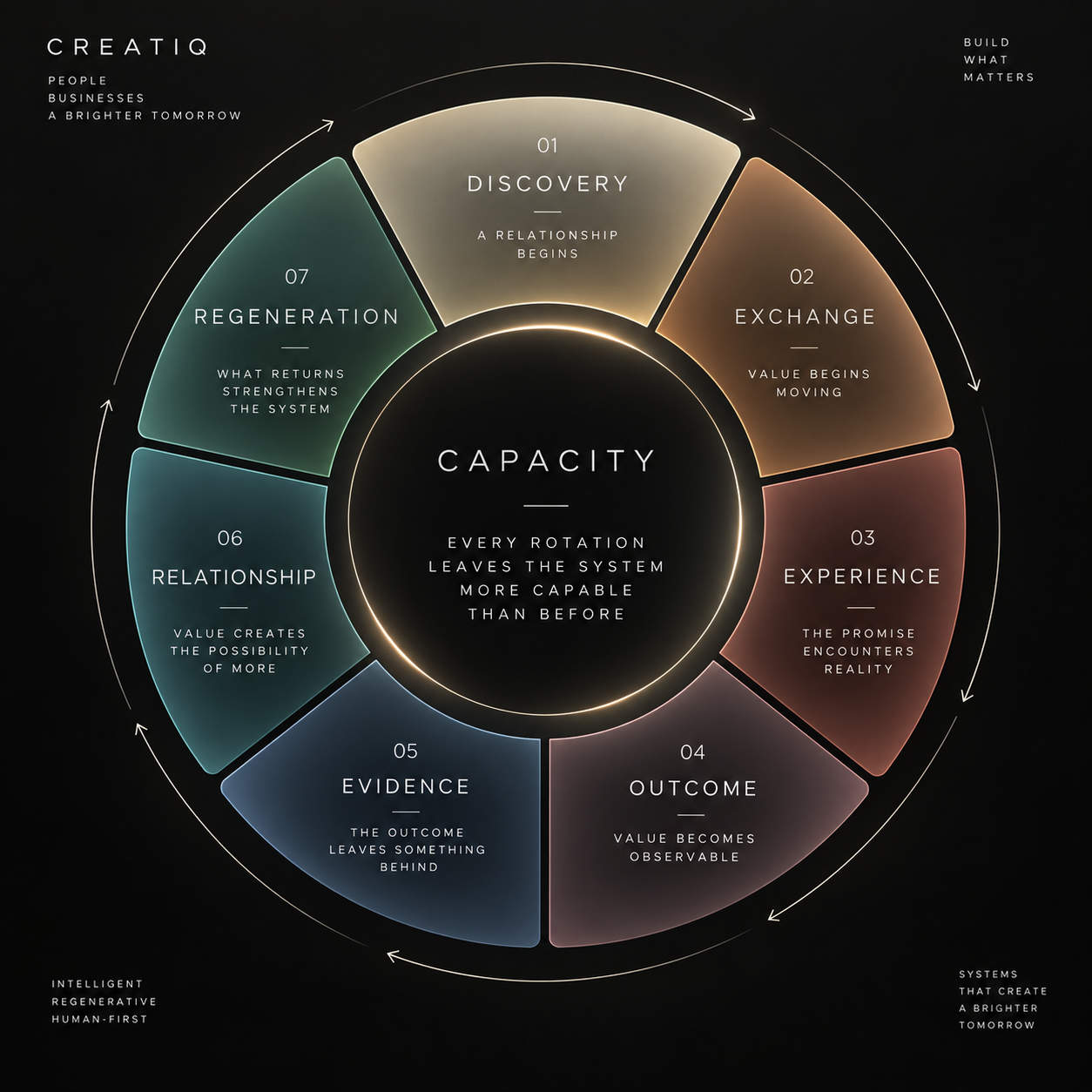
At the center of the wheel is something we believe businesses should pay far more attention to:
Capacity.
Because the important part isn't simply that the circle keeps turning.
A circle can repeat forever without improving anything.
The important question is:
Does each rotation leave the system more capable than it was before?
The customer becomes more capable because their problem was genuinely solved.
The business becomes more capable because it earned revenue, knowledge, evidence, reputation and relationships.
Employees can become more capable because the business can invest in better tools, systems, compensation, knowledge and meaningful work.
Partners can become more capable because new opportunities and relationships flow through the ecosystem.
Communities can become more capable because knowledge, trust and connection accumulate within them.
And the business itself learns.
It improves the product.
It improves the experience.
It understands its customers more deeply.
It builds stronger relationships.
It creates better outcomes.
Those better outcomes produce stronger evidence, deeper relationships and greater capacity to serve the next person who enters the system.
That's the difference between circulation and regeneration.
A circular system simply returns to where it started.
A regenerative system returns stronger.
Growth still happens.
Profit still happens.
Demand still happens.
But they become consequences of an architecture that continually creates and recirculates value rather than simply pulling value toward the center.
Every rotation should leave the system more capable than before.
That's the Regenerative Flywheel.
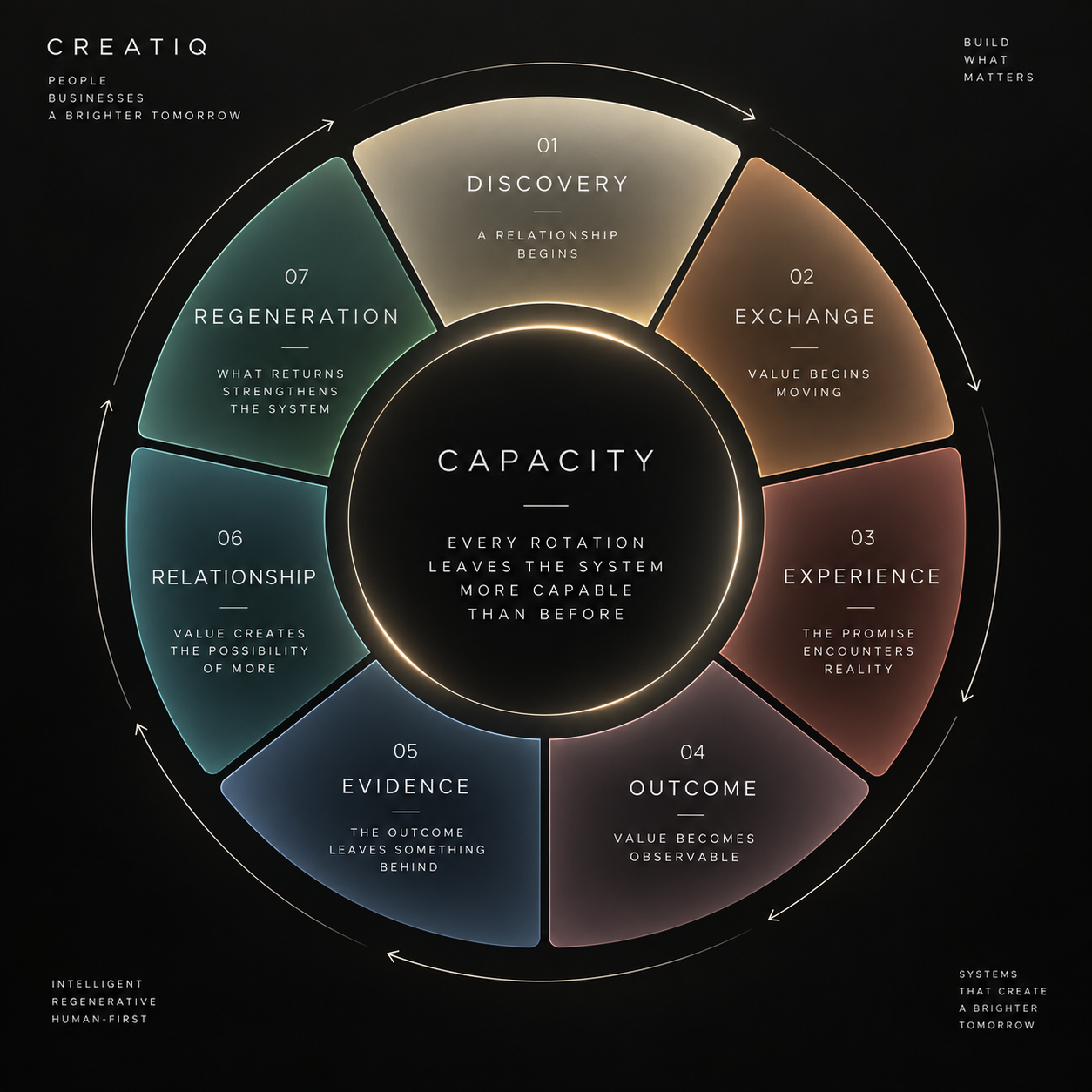
The important part isn't the circle.
The important part is what happens to the participants while the circle turns.
They should become more capable.
The customer becomes more capable because their problem was genuinely solved.
The business becomes more capable because it earned revenue, knowledge, reputation and relationships.
Employees become more capable because the company can invest in better tools, systems, compensation and meaningful work.
Partners become more capable because new opportunities flow through the ecosystem.
The community becomes more capable because knowledge and relationships accumulate within it.
And ideally, the wider system becomes more capable because some of the value created returns to the conditions that made that value possible.
Growth still happens.
Profit still happens.
Demand still happens.
But value isn't simply pulled toward the center.
It circulates.
A funnel consumes. A flywheel compounds.
This is the fundamental difference.
A traditional funnel asks:
How do we move this person toward a transaction?
The Regenerative Flywheel asks:
How do we create an exchange that makes the entire relationship more valuable after the transaction than it was before it?
The funnel has an endpoint.
The flywheel has memory.
The funnel converts attention.
The flywheel compounds trust.
The funnel needs replenishment.
The flywheel can create its own momentum.
The funnel measures how efficiently people move toward the business.
The Regenerative Flywheel also asks what happens to people because they encountered the business.
That last question matters enormously to me.
The best businesses already behave this way
Think about a truly extraordinary local restaurant.
You don't merely buy dinner.
You know the owner.
The owner knows the farmer.
The staff know the regulars.
People bring friends.
Birthdays happen there.
Deals happen there.
Relationships begin there.
The restaurant becomes part of the social fabric around it.
Money moves through the business, but something else accumulates alongside it.
Relationship capital.
Or consider a brilliant independent clothing company.
It could optimize for selling you as many disposable garments as possible.
Or it could make something worth keeping.
Teach you how it was made.
Know the people who produced it.
Repair it.
Create gatherings around the culture surrounding it.
Invite customers into something larger than a checkout page.
One model asks:
How many units can we move?
The other asks:
What can we cause to flourish around this company?
Both can make money.
But they create very different systems.
I think small and medium businesses have an extraordinary opportunity
For decades, the advantage belonged disproportionately to scale.
Scale bought distribution.
Scale bought advertising.
Scale bought shelf space.
Scale bought media.
Scale bought attention.
The internet changed part of that.
AI is about to change another part.
But there is a deeper change happening underneath both.
Businesses can now coordinate communities at a scale that was previously difficult without becoming giant institutions themselves.
A thousand extraordinary customers can be more valuable than a million anonymous impressions.
A trusted email list can matter more than rented reach.
A private community can create relationships that an advertising dashboard cannot.
A founder with a clear North Star can gather customers, partners, suppliers, creators and collaborators around something they genuinely believe should exist.
This doesn't mean advertising disappears.
We use advertising.
It remains one of the most powerful mechanisms ever invented for creating reach.
But businesses should understand the dependency they create when they rely entirely on platforms they do not own.
Regulators have spent years examining concentration, market power and opacity in digital advertising markets. The ACCC's most recent digital-platform work continues to identify competition and consumer concerns across digital markets. ACCC
So our principle at Creatiq is becoming increasingly simple:
Rent distribution. Own relationships.
Use advertising.
Use search.
Use social media.
Use AI.
Use marketplaces.
Use every useful channel available to you.
But bring the relationship home.
Because a customer isn't an impression.
And a community isn't a targeting segment.
From audiences to communities to tribes
I think the next generation of extraordinary businesses will increasingly build something around the company itself.
A community.
A network.
A movement.
In some cases, perhaps even a private society.
Not as a marketing gimmick.
As architecture.
People gather around shared beliefs all the time.
They gather around sports teams.
Religions.
Universities.
Professions.
Music.
Hobbies.
Cities.
Causes.
Ideas.
The strongest brands have always understood some version of this.
But I think we can take it further.
What if the business had a North Star clear enough that people understood not only what it sells, but what kind of world it is trying to create?
Then the relationship changes.
You aren't simply acquiring customers.
You're finding people who want to participate.
And when those people receive genuine value, they carry the idea further.
This is where demand becomes regenerative.
The customer can become part of the distribution architecture
Traditional advertising works largely because the business pays to enter someone's field of attention.
A regenerative business has another possibility.
Its customers can voluntarily carry it.
Not because we built a referral trick into the checkout flow.
Because something happened that was worth talking about.
A result.
An experience.
A transformation.
A relationship.
A story.
A belief.
Something they want another human being to experience.
That creates a completely different form of reach.
The customer becomes an advocate.
The advocate creates awareness.
Awareness creates another relationship.
The new relationship creates another outcome.
That outcome creates more evidence.
The evidence strengthens reputation.
Reputation reduces friction.
Reduced friction makes future demand easier to convert.
And suddenly marketing isn't a line anymore.
It's circulation.
This changes what we should measure
Revenue matters.
Profit matters.
Margin matters.
Customer acquisition cost matters.
Lifetime value matters.
I don't want businesses to stop measuring any of those things.
I want us to add another question.
What became more capable because this transaction happened?
Did the customer become more capable?
Did our people?
Did our partners?
Did our suppliers?
Did the community?
Did the business?
Did the environment around the business become stronger or weaker?
Imagine putting that question next to the P&L.
It would reveal things the P&L cannot.
Because financial statements tell us where money accumulated.
They don't necessarily tell us what flourished.
This is becoming part of how we think at Creatiq
You've heard me talk before about building intelligent companies.
About AI releasing human capacity rather than replacing it.
About founders becoming founders again.
About creating businesses that can grow without consuming the humans inside them.
The Regenerative Flywheel is another part of that architecture.
Because I don't think the company of the future should merely become more efficient at extracting value.
I think it should become extraordinarily good at creating value that creates more value.
For customers.
For employees.
For founders.
For partners.
For communities.
For the systems around them.
That's regeneration.
And it gives us a much more interesting definition of growth.
Maybe the funnel was never wrong
Maybe it was simply incomplete.
There is still a journey toward exchange.
Someone still has to discover you.
You still need their attention.
You still need to become relevant.
They still need to understand you.
Desire still matters.
Trust still matters.
Conversion still matters.
But conversion isn't the bottom.
It's the hinge.
Everything before conversion asks whether enough value can be perceived for an exchange to happen.
Everything after conversion reveals whether the value was real.
That is where the magic begins.
The customer experiences the promise.
The business receives evidence.
The relationship deepens.
Knowledge returns.
The product improves.
People tell other people.
The community strengthens.
Demand regenerates.
And value begins circulating rather than simply terminating at the transaction.
We can architect better systems
I don't expect us to redesign global banking tomorrow.
Or healthcare.
Or education.
Or government.
Or media.
Or law.
Those are enormous systems with histories, constraints, tradeoffs and responsibilities far more complicated than a single Journal article could possibly capture.
But businesses are systems too.
And those we can redesign.
A founder can decide how employees are treated.
A company can decide how suppliers participate.
A brand can decide whether its products are built to endure.
A business can decide whether customers remain anonymous transactions or become relationships.
A company can decide whether knowledge is hoarded or shared.
A founder can decide whether growth consumes human capacity or creates more of it.
And thousands of businesses making those decisions begins to look like something much larger.
This is why I remain extraordinarily optimistic.
We don't have to wait for someone to redesign the world for us.
We can begin building better architectures inside the systems we already control.
One company.
One product.
One relationship.
One exchange at a time.
And perhaps, eventually, those systems begin connecting with one another.
Businesses supporting businesses.
Communities supporting producers.
Capital supporting creation.
Technology increasing human capacity.
Customers becoming participants.
Participants becoming advocates.
Value moving in circles instead of disappearing into endpoints.
That's the world I'm interested in building.
Not a world without profit.
A world where profit becomes evidence that value has been created, while the architecture ensures that value continues circulating.
The question isn't simply how much value your business can capture.
The better question is how much value can exist because your business does.
That's the Regenerative Flywheel.
And I think we're only beginning to understand what becomes possible when it starts turning.
Peter Luis Venero
Founder, Creatiq